

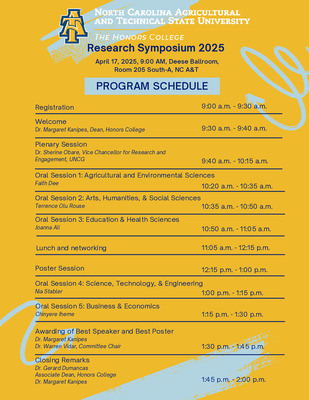
Held on April 17, 2025, at North Carolina Agricultural and Technical State University, the Honors College Research Symposium celebrates undergraduate research excellence across multiple disciplines. Students presented oral and poster sessions that reflect their commitment to academic inquiry, innovation, and faculty-mentored scholarship.
This collection features abstracts from student presentations across areas including:
- Agricultural and Environmental Sciences
- Arts, Humanities, and Social Sciences
- Education and Health Sciences
- Business and Economics
- Science, Technology, and Engineering
These abstracts represent original research conducted by Honors students and serve as a testament to their scholarly contributions. Posters will be added as permissions are secured.
-
“Photoswitchable” Directing Template for Remote C-H Bond Functionalization
J’ya G. Massey and Stefan M. Cooper Jr. Ph.D.
Molecular photoswitches allow external control over molecular structure and reactivity using light. We proposed creating a photoswitching directing template for opportunities in regio-divergent site-selectivity and unique geometrical approaches to remote C-H bonds. A photoswitchable "C-shaped" directing template will be designed from the excited “T-shaped” conformers of azo heteroarenes to investigate functionalization by switching between trans and cis conformers under light. This work will share our initial synthesis of key intermediates and studies of their photoswitchability. We end by outlining our future work for realizing goals in remote C-H functionalization with projected screening conditions for optimal functionalization.
-
Protein Content is Higher in Sickle Cell Mice Compared to Control Mice, Potentially Due to Mitochondrial Content Within the Soleus Muscle, Specifically in Sickle Males
Nia Stabler, Maria Clara Canellas da Silva, and Sarah Kuzmiak-Glancy
Sickle Cell Disease (SCD) is characterized by restricted oxygen delivery to various tissues. Oxygen is crucial for ATP production in mitochondria, which is necessary for muscle contraction. This study aimed to compare protein and mitochondrial content in the soleus, extensor digitorum longus (EDL), and tibialis anterior (TA) muscles in sickle cell mice versus control mice, focusing on the potential impact of mitochondrial content on muscle function. Grip strength was measured in live mice using repeated trials while they gripped a platform. Protein content was assessed with a bicinchoninic acid (BCA) assay, and mitochondrial content was evaluated using citrate synthase activity in muscle homogenates. Mitochondrial content in the soleus muscle correlated significantly with grip strength. Sickle mice exhibited higher protein content in the soleus, EDL, and TA muscles compared to controls, with statistically significant differences in the soleus (p=0.009) and EDL (p=0.036) muscles. Additionally, mitochondrial content was higher in sickle males compared to controls (p=0.039). The study suggests that increased mitochondrial content in sickle males, particularly in the soleus muscle, may be a compensatory response to metabolic demands imposed by SCD. These findings highlight the importance of mitochondrial adaptations in muscle performance and suggest potential therapeutic targets to address mitochondrial dysfunction in SCD.
-
Racial Discrimination, Social Support, and Perceived Qualification Differences: Analyzing The Impacts on Work-Related Stress and The Mental Health of Black Women
Nyasha Chikwinya and Cayla Johnson
Through this study, this research looks at how racial discrimination at work that is perceived, has impacts on the mental health of Black women. We tend to focus on major issues such as stress, anxiety, and depression. The main ideas we will be exploring include: 1. Facing racial discrimination at work is stressful. Black women who deal with this can experience more psychological stress, 2. Having access to a support system or mentorship at work can help lessen the bad effects of work-related stress on Black women's health, and 3. When Black women see themselves as inferior to their white counterparts, it can make mental health issues worse, leading to more consistent anxiety and depression. Moreover, we are examining factors such as racial bias, access to support, and how Black women are viewed in the workplace qualification wise. Additionally, these factors are the independent variables of the research. The outcomes we’re researching and looking at are how Black women feel about work stress, their mental health (factors like stress and anxiety), and how fair they think their workplace is. To gather our information, we will use a variety of scales and surveys that are tested for reliability. Overall, our goal is to have a better understanding on how workplace interactions, especially those surrounding race, impact Black women's mental health. Also, we want to bring awareness to and highlight how important establishing support systems and perceptions of fairness are.
-

Racial Discrimination, Social Support, and Perceived Qualification Differences: Analyzing The Impacts on Work-Related Stress and The Mental Health of Black Women
Cayla Johnson and Nyasha Chikwinya
Prior research indicates that racial discrimination greatly affects the mental well-being of Black women in their jobs (Berdahl and Moore, 2006). This matter is vital since the compounded impacts of racial discrimination can intensify job-related stress and lead to persistent mental health issues, such as anxiety and depression (Holder et al, 2015). We propose a study examining how racial discrimination at work is perceived and how it impacts mental health of Black women. Specifically, we hypothesize: H1. Black women who deal with racial discrimination can experience more psychological stress. H2. Having access to a support system or mentorship at work can help lessen the bad effects of work-related stress on Black women's health. H3. When Black women see themselves as inferior to their white counterparts, it can make mental health issues worse, leading to more consistent anxiety and depression. A survey will be conducted online to test the hypotheses. The results of the current study will enable a better understanding on how workplace interactions, especially those surrounding race, impact Black women's mental health. It will also bring awareness to and highlight how important establishing support systems and perceptions of fairness are.
-
Reparative Impact in United States Municipalities
Terrence Olu Rouse
Although national reparation programs have not gained significant traction in the United States, recent local reparation programs provide a promising opportunity for further research of the impact of reparative policy. The literature on reparation programs largely focuses on proving or disproving whether reparation programs have any historical significance, legality, or impact at all. A policy brief from the Urban Institute titled “Justice, Equity, and Repair: How Local Governments in the US Are Designing Reparations Programs” and research published by Duke University Scholar William Darity Jr. exemplify some studies on how the history of slavery, redlining, voter suppression, and mass incarceration have perpetuated racial disparities and calls for reparations for the black community. This research design aims to address the gap by examining whether local reparation initiatives in four United States municipalities contribute to closing the racial wealth gap and measuring what the impact is. This research will explore these reparation programs by using quantitative data and regression analysis to create synthetic control methods to model the impact. This research is essential to establish the stark differences in income and poverty between black and white Americans. Moreover, the results will uncover to what effect reparations effectively repair and address the black community needs.
-
Scaling Black Entrepreneurship: The Missing Link of Mentorship
Tamara Daye and Juliet Osuji Ph.D.
Mentorship plays a crucial role in entrepreneurial success, yet Black entrepreneurs often face a significant mentorship gap that limits business growth. Existing mentorship programs within entrepreneurial ecosystems have shown mixed effectiveness, highlighting the need for culturally relevant models tailored to the Black community. This study explores how Black mentorship programs can bridge systemic barriers in business development, financial literacy, and network access. Using qualitative research, we analyzed ten articles, selecting seven for open coding. Some key categories included “knowledge and network contacts,” “development opportunities,” and “representation of professionals of color.” Axial coding further identified essential themes like “network building for resource access” and integrating both practical and academic entrepreneurship knowledge. Findings suggest that effective Black entrepreneurship ecosystems should provide resource access, mentorship from professionals of color, and a balance of academic and hands-on learning. Incorporating technology can also expand mentorship opportunities to reach geographically distant entrepreneurs. This research underscores the importance of mentorship in overcoming systemic barriers. By fostering organic, culturally attuned programs, Black entrepreneurs can access the resources, knowledge, and networks necessary for business sustainability. Future research should assess these models' real-world impact and explore broader implementation strategies.
-
Screening cell adhesion molecules for a role in regeneration after pinch injury in Drosophila neurons
Jada N. Mars, Mia A. Brantley, and Katherine L. Thompson-Peer
Dendrites are outgrowths from the cell body, or soma, of neurons. The primary function of dendrites is to receive information from other neurons or surrounding tissues. We use the ddaC Class IV neurons of the fruit fly Drosophila melanogaster PNS, or peripheral nervous system, to study dendrite regeneration and why dendritic arbors regenerate imperfectly. The interaction between the dendrites and these surrounding tissues are mediated by different proteins and receptors, called cell adhesion molecules (CAM). The study objective is to perform a screen to determine obvious visual differences in dendrite regeneration after downregulating the expression of different CAMs through RNA Interference (RNAi). To induce injury, we perform a pinch injury with forceps. This holistic tissue injury method damages the ddaC neuron along with the surrounding tissue which includes the epidermis, supportive glial cells, and the extracellular matrix (ECM). The findings of this project highlight how the downregulation of CAMs by RNAi can demonstrate the role that CAMs and the surrounding tissues have on the regeneration of dendrites. The Drosophila melanogaster is ideal for studying dendrite regeneration as it shares many genes and biological pathways with humans, the use of the model organism allows for the mirroring of holistic tissue injury, such that is observed in traumatic brain injury in humans.
-

Sex-Specific Steroid Levels After Acute Ethanol Exposure in Adult Mice
Myla Fowlkes and Antoniette M. Maldonado-Devincci Ph.D.
Heavy alcohol exposure can cause long-term physiological changes, with a potential for sex-specific differences in ethanol metabolism and immune response. This study investigates the impact of acute ethanol exposure on endocrine markers in adult male and female C57BL/6J mice. A total of 16 mice (8 male, 8 female) were divided into ethanol-exposed (n = 4 per sex) and control (n = 4 per sex) groups. Ethanol-exposed mice received intraperitoneal (i.p.) injections of 2.0 g/kg ethanol (20% v/v) twice, five days apart. One hour post-injection, blood samples were collected by submandibular sampling, centrifuged, and analyzed for 17B-estradiol using an enzyme-linked immunosorbent assay (ELISA). To assess immune activation post-ethanol exposure, estradiol concentrations were measured with an 17B-Estradiol ELISA Kit. The results reveal significant sex-specific and ethanol-induced effects on 17B-estradiol levels. In male mice, ethanol exposure resulted in a significant decrease in estradiol levels compared to saline controls (p = 0.0386), similar results were observed in adult female mice (p = 0.0063). In addition, a comparison between male and female saline-treated groups suggests that baseline estradiol concentrations are naturally higher in females than in males (p = 0.0193). These findings suggest that acute ethanol modulates 17B-estradiol differently in males and females, potentially contributing to sex-specific neural and immune responses to alcohol.
-
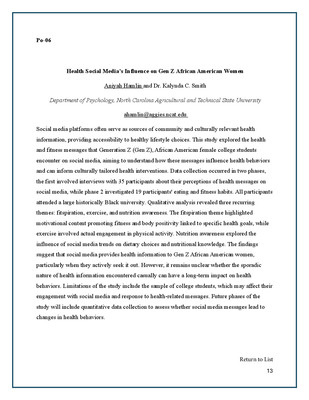
Social media spaces catered to Generation Z African American women
Ja’nia Monroe and Kalynda C. Smith Ph.D.
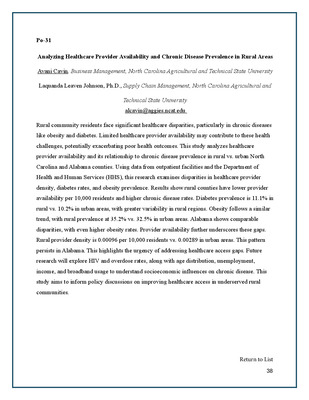
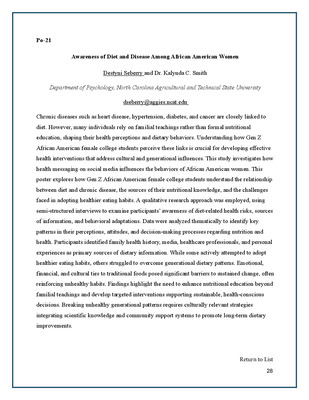
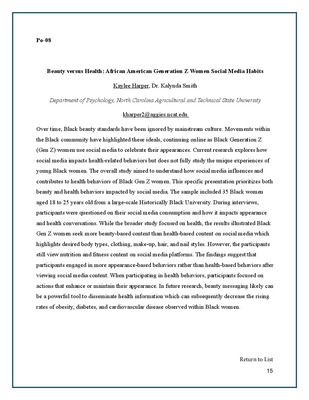
Social media and internet usage are engrained within Generation Z communication, trends and norms. This study seeks to understand the specific niche African American Generation Z women exist in and the content and spaces catered to them. With this knowledge, social norms and expectations perceived from internet posts by Generation Z African American women can be better understood. The study utilizes qualitative data from a sample of 35 Generation Z African American college students who provided insights about their social media usage and the types of content they see. The findings demonstrated that students felt that intentionally created spaces for Generation Z African American women were limited. Most of the catered content found by users, was created by Generation Z African American women. Most internet content is understood by users to be unrealistic, and they are aware of this, making conscious efforts keep their self-esteem unaffected. These niche spaces tend to be difficult to find, leaving women searching keywords like “black girl” to gain access. Despite being hard to find, Generation Z African American women are the origin of many trends on social media platforms such as Instagram and TikTok. While a limited amount of spaces cater to them, Generation Z African American women have created some of their own, which is evident from content being created by and for them. By expanding these online spaces and facilitating users access, they would become less limited and more diverse in the content they provide.
-
Targeting Injured Cardiomyocytes with RNA Sensors
Krista Edwards, Sydney Versen B.S., and Ravi Karra M.D.
Cardiovascular diseases remain a leading cause of mortality due to cardiomyocytes' inability to proliferate and regenerate after injury. Current therapies that broadly express regenerative factors in the heart are ineffective. However, targeted expression of these factors to the injury can induce cardiomyocyte proliferation. Our research introduces an innovative technique that can deliver regenerative factors directly to the injured myocardium using a biomarker uniquely expressed by injured cardiomyocytes, Natriuretic Peptide B (Nppb). Our research utilizes the CellREADR system, an ADAR-based RNA sensor that detects Nppb expression and induces translation of regenerative cardiac factors. The overall goal of this study was to identify the most efficient sensor. In the unamplified construct, all transfected cells express BFP (blue fluorescent protein). When Nppb mRNA is present, it binds to the sensor and recruits the ADAR enzyme, allowing RNA editing and GFP (green fluorescent protein) translation. The amplified construct incorporates a tetracycline-controlled transcriptional activation system to enhance GFP expression. HEK293T cells were transfected with these constructs and Nppb coding sequence, then sensor efficiency and specificity were assessed by counting GFP+ cells in experimental and control groups. The unamplified sensor successfully detected Nppb with minimal background activity. However, the amplified sensor showed unintended GFP expression in negative controls, indicating non-specific expression. Optimization efforts are underway to refine specificity by incorporating additional upstream regulatory elements. Our findings demonstrate the potential of RNA sensors in targeting injured cardiomyocytes, contributing to gene-based strategies for cardiac regeneration and repair.
-
The Erasure and Confinement of Black Teenage Girlhood in Media
Jasmine Bell
The media has shaped Black perception, rooting back to slavery, and continues to plague the Black community today, specifically Black teenage girls. Hollywood presents Black girls coming of age as a disappearance, especially now, erasing them from the screen and confining Black teenage girlhood to harmful tropification. Through the lens of Black Feminist theory and Black Girlhood Studies framework, I will examine the rise of the disposable Black girl trope, race swapping, and the token Black girl character since the 2010s to now versus the difference in the representation of Black girlhood on TV in the 90s and 2000s. This research will seek to understand the intersectionality of Black girlhood through mixed methods research, defining the common themes in the current state of Black girlhood in Hollywood. Thus far, the research in this field suggests that adultification, whitewashing, and neglecting of Black teenage girls attributes to this problem. Through my research, I hope to expand these ideas through specific case studies of Black sitcoms, erasure of the monoracial Black actress, and lack of effort toward these projects from their production companies.
-
Theory to Practice: Applications for Transforming School Violence and Maladaptive Behaviors in Black and Latino Males.
Matthew Johnson
Motivated by the need to counter negative social influences and maladaptive behaviors, this study aims to address the impact of living with and experiencing violence in schools. While a vast body of literature discusses the prevalence and consequences of school violence, there is a significant lack of solution-oriented research that provides actionable strategies for effectively addressing and preventing these issues. Guided by the question do collaborative school environments reduce maladaptive behaviors in Black and Latino male students, this study bridges theory and practice in diverse high school settings. Using an educational equity framework and evidence-based interventions, it aims to offer insights that could reshape practices and policies on school violence, supporting historically marginalized student populations.
-
The Relationship Between Market Characteristics and Players' Salaries in the WNBA
Brian Roper-Nelson and Eduardo G. Minuci Ph.D.
This study examines the relationship between market characteristics, player nationality, and compensation in the Women’s National Basketball Association (WNBA), addressing gaps in understanding foreign player wage dynamics. Utilizing a unique dataset of WNBA contracts from 2017 to 2023, we analyze how city demographics influence salaries, particularly for foreign players without NCAA experience. Using weighted least squares (WLS) models, we find that foreign players earn higher wages the higher the share of the white population of the metropolitan area where the team resides. This effect is stronger for foreign players who did not attend U.S. colleges, emphasizing the role of consumer characteristics and preferences in shaping salary structures. Our study provides important implications for team composition and contract negotiation strategies that are particularly relevant to these firms facing restrictions on overall expenses on player compensation. Our future research aims to investigate if signing foreign players is linked to changes in attendance, gate revenue, and team performance.
-
The Role of Interferons in Vulnerable Plaque
Jor’Dan Whitt, Lydia Kwee Ph.D., and Svati Shah M.D
Coronary artery disease (CAD) is a leading cause of death in the U.S., driven by atherosclerosis and leading to myocardial infarction (MI). Vulnerable plaque can rupture without obstructive CAD, releasing inflammatory and thrombotic proteins. Interferon signaling is implicated in this process. The hypothesis is that circulating interferon levels are associated with vulnerable plaque even without obstructive CAD. Two cohorts were analyzed: the PROMISE study (1,700 patients with chest pain, including 12% Caucasian) and the Miami Heart Study (2,352 healthy individuals, 85% Caucasian, 47% Hispanic/Latino). Inflammatory proteins were measured using the Olink platform for specificity and efficiency. Logistic regression models assessed interferon associations with CAD and vulnerable plaque. IFN-gamma levels were higher in the PROMISE cohort. IL-18, IL-18R1, and IL-12B were assessed, with IL-18 showing the strongest correlation to interferon activity. Interferon proteins are associated with CAD and vulnerable plaque, activating macrophages and promoting inflammatory protein secretion. These proteins may serve as clinically relevant biomarkers for CAD.
-
Upconversion Enhancement by Plasmonic Nanocavities
Akasha Ray, Muzan Ebrahem, Amya Allen, Tianna James, Dorcas Godspower, Tristin Howell, and Rachel Bangle
Upconversion is the process of converting multiple low energy photons into one high energy photon capable of driving important chemical reactions. It carries promising potential for applications including photocatalysis, bioimaging, and therapeutic technologies. The light emitted from solid state upconverting thin films, however, is too dim for many applications. This is because the solid matrix prevents diffusion of donor and acceptor molecules and thus slows the multiple intermolecular energy transfer steps required for upconversion. In order to increase this emission, we are integrating molecules known to undergo upconversion into plasmonic nanocavities which produce extreme electric fields. We build these molecules into either molecular organic frameworks (MOFs) or supramolecular assemblies to control the relative orientations of the donor and acceptor molecules. We hypothesize that orienting the donor molecules (porphyrin derivatives) and acceptor molecules (anthracene derivatives) parallel to the electric field direction in the cavities will cause the field to promote intermolecular energy transfer. In this presentation, we will report on progress in synthesis of colloidal nanocubes, synthesis of donor and acceptor molecules, and exfoliation of 3D MOFs into 2D MOFs suitable for nanocavity integration. The creation of these samples will allow us to measure emission brightness and kinetics for various molecular orientations to determine how the electric fields affect energy transfer rates and yields.